Outsourced-estimating - 11/2/2026
In-house-vs-Outsourced-estimating
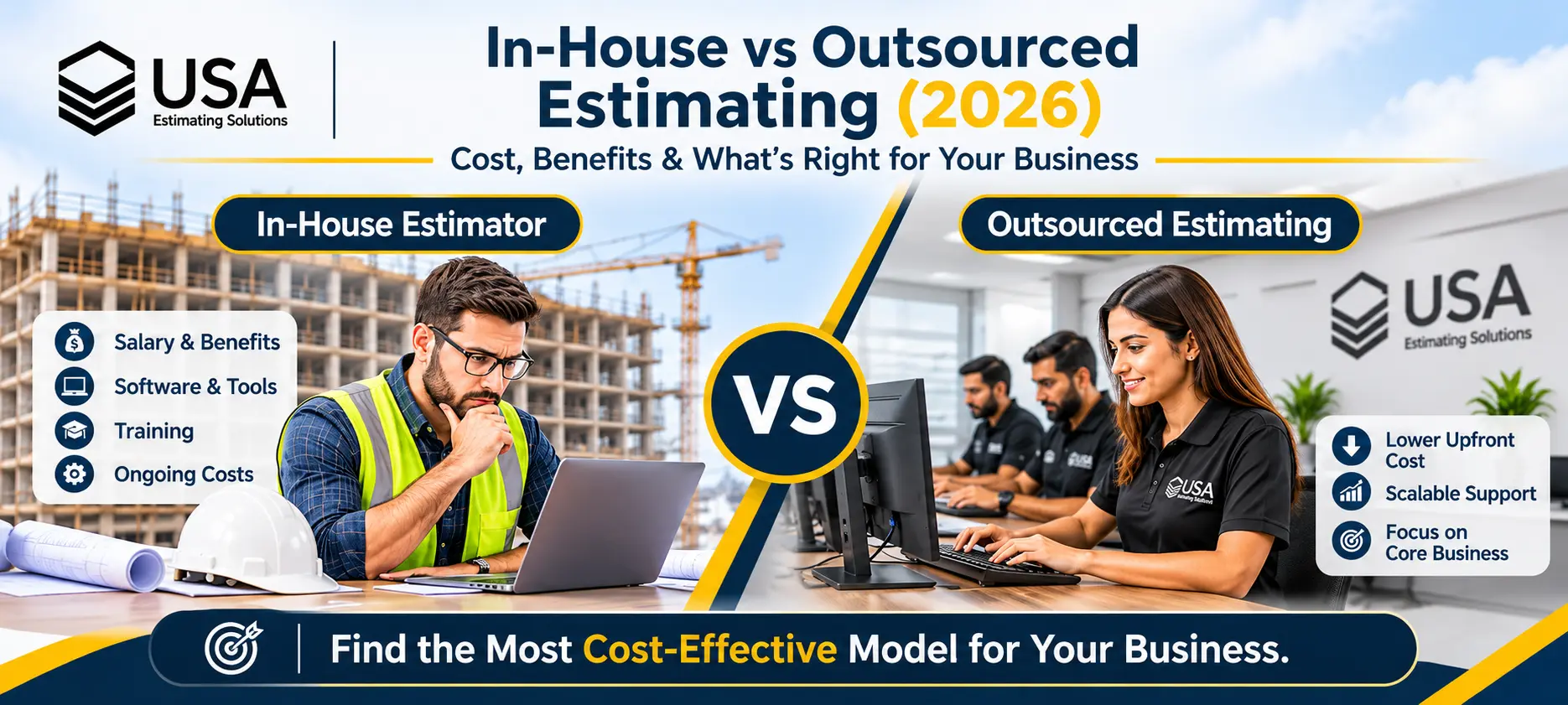
In-House Estimator vs. Outsourced Estimating: What It Really Costs in 2026
By USA Estimating Solutions · November 2, 2026
Quick Takeaways
- A full-time construction estimator costs roughly $121,000 a year once you add benefits to the median salary, before software, cost data or a desk.
- Outsourced estimates are paid per job, so the cost drops to zero in a slow month.
- At typical outsourced prices, one in-house estimator only pays for itself above roughly 135 to 300 estimates a year, depending on scope.
- In-house wins on control and day-to-day coordination; outsourcing wins on flexibility and trade coverage.
- Many growing contractors split the work: strategy and final pricing in-house, takeoffs and overflow outside.
At some point every growing contractor hits the same wall. Bids are coming in faster than anyone can price them, the owner is doing takeoffs at 10 p.m., and the obvious fix seems to be hiring an estimator.
Sometimes that's the right call. Often it isn't, at least not yet. A full-time hire is a fixed cost you carry through every slow season, while outsourced estimating flexes with your bid calendar.
This post lays out the real numbers on both sides, using federal wage and benefits data, published software prices and our own rate card. You'll see a full cost build-up, a break-even calculation you can run on your own volume, and an honest look at when each option comes out ahead.
USA Estimating Solutions is an outsourced estimating firm, so we have a stake in this question. That's exactly why we've shown the math, including the cases where hiring in-house is the smarter move.
The Short Answer
Outsourcing is usually cheaper for contractors pricing fewer than about 135 to 300 estimates a year, or those whose bid volume swings from month to month. An in-house estimator makes more sense once you have steady, high volume, a narrow set of trades and a need for someone who sits in on preconstruction meetings every week.
The rest of this guide shows where those numbers come from, so you can plug in your own.
What an In-House Estimator Really Costs
A full-time estimator costs far more than the salary on the offer letter. Once benefits and payroll taxes are added, the real figure for a typical building-construction estimator lands around $121,000 a year, and that's before tools.
Here's how it builds up, using 2025–2026 federal data:
| Cost item | Annual cost | Basis |
|---|---|---|
| Base salary | $84,610 | Median wage for cost estimators in building construction, May 2025 (BLS) |
| Benefits and payroll taxes | about $36,260 | Benefits make up 30% of total compensation in private industry, June 2026 (BLS ECEC) |
| Total compensation | about $120,870 | Salary ÷ 0.70 |
| Takeoff software | $330+ | Bluebeam Revu Core, per user per year (Drawboard) |
| Cost data, second takeoff tool, training | Varies | Often several thousand dollars more |
| Recruiting and ramp-up | Varies | Weeks to months before a new hire prices your work confidently |
Two costs never show up on a spreadsheet. The first is the ramp-up period, when a new estimator is learning your crews, suppliers and markup habits. The second is idle time: in a slow month, you're still paying full salary for someone with little to price.
Median pay is just that, a midpoint. Estimators in heavy and civil work earn more, and senior estimators in large metros can cost well above these figures.
What Outsourced Estimating Costs
Outsourced estimating is priced per project, so you pay for output instead of hours. At USA Estimating Solutions, published starting prices are:
| Plan | Starting price | Best for | Turnaround |
|---|---|---|---|
| Basic | $200 | Single trade or limited scope | 2–3 business days |
| Standard | $400 | Multi-trade, GC bids | 3–4 business days |
| Premium | $900 | Full GC, all trades | 3–5 business days |
Every plan includes quantity takeoffs and color-coded takeoff sheets. Standard adds labor and material pricing plus a GC summary, and Premium includes overhead and profit. Full details are on our estimating plans and pricing page.
The tool costs are absorbed into those prices. Our estimators already work in Bluebeam, PlanSwift, RSMeans and Xactimate, so you don't buy or maintain those licenses yourself.
The Break-Even Math
The break-even point is the number of estimates per year at which a salaried estimator costs the same as outsourcing. Divide the in-house cost by the price per outsourced estimate:
Break-even estimates per year = Annual in-house cost ÷ Price per outsourced estimate
Using about $121,200 a year (total compensation plus one Bluebeam license):
| Outsourced scope | Starting price | Break-even per year | Per week (50 weeks) |
|---|---|---|---|
| Single trade | $200 | about 606 | about 12 |
| Multi-trade | $400 | about 303 | about 6 |
| Full GC | $900 | about 135 | about 3 |
Worked example. A commercial GC bids eight multi-trade jobs a month. That's 96 estimates a year, or about $38,400 at the $400 starting price, against roughly $121,000 for a hire. Outsourcing costs about a third as much.
Now take a busier firm pricing 30 multi-trade bids a month. That's 360 a year, or $144,000 outsourced. At that volume a dedicated in-house estimator starts to make financial sense, as long as one person can actually keep up.
Two cautions. These are starting prices, and larger or more complex projects cost more to outsource, which lowers the break-even point. On the other side, one in-house estimator has a ceiling on how many detailed bids they can finish, so high volume often means hiring two.
In-House vs. Outsourced Estimating: Side by Side
| Factor | In-house estimator | Outsourced estimating |
|---|---|---|
| Cost structure | Fixed, about $121,000+ a year | Variable, paid per estimate |
| Cost in a slow month | Full salary continues | Close to zero |
| Capacity | One person's hours | Scales with bid volume |
| Trade coverage | Strongest in the hire's background | Trade-specific estimators per scope |
| Software and cost data | You buy and maintain | Included in the price |
| Start-up time | Recruiting plus ramp-up | First estimate often in 24–48 hours |
| Knowledge of your crews | Builds up over time | Comes from your notes and past bids |
| Day-to-day availability | In the office, at precon meetings | By email and call |
| Confidentiality | Internal | NDA on request |
When Keeping It In-House Makes Sense
Hiring your own estimator is the better move in a few clear situations:
- Your bid volume is high and steady, comfortably above the break-even numbers above, every month of the year.
- You work in one or two trades, so a single specialist can cover everything you price.
- Estimating and project management overlap, and you need the estimator in owner meetings, value-engineering sessions and buyout.
- You run a negotiated or design-build model where the estimator works alongside the design team for months on the same job.
If that describes your company, an in-house hire builds knowledge that's hard to replace: how your crews really perform, which suppliers come through, and which owners pay on time.
When Outsourcing Wins
Outsourcing comes out ahead when your needs move around:
- Bid volume swings with the season or with a few large invitations.
- A job includes trades you don't normally price, like a GC suddenly bidding a project heavy in MEP or glazing.
- You're between hires or your estimator is out, and bids won't wait.
- You want to bid more work without adding fixed overhead first.
For contractors who want one consistent person without a full-time hire, a dedicated construction estimator works on your projects like a remote team member. For occasional or one-off bids, freelance construction estimating is the lighter option.
The Hybrid Model Most Growing Contractors Use
You don't have to choose one or the other. The setup we see most often among growing contractors splits the work by judgment versus volume:
- Keep in-house: bid strategy, sub and supplier relationships, final pricing, markup decisions and the go/no-go call.
- Send out: quantity takeoffs, unfamiliar trades and overflow bids during busy weeks.
This keeps your margins and client relationships in your own hands while removing the hours of measuring that bury most estimators. Many firms start by outsourcing only quantity takeoffs, then expand the arrangement once they trust the output.
How to Vet an Outsourced Estimating Firm
Not every outside estimator is worth handing your bid to. Before you send a full plan set, check these:
- Ask for sample estimates in your trade. A firm that can't show you real deliverables is a risk. You can browse our sample estimates for electrical, HVAC, drywall, glazing and full GC scopes.
- Confirm local pricing. Ask how labor and material rates are set. For bid work, zip-code-based data is far more reliable than national averages.
- Get a delivery date in writing before you pay, not a vague "a few days."
- Ask how many revisions are included. Addenda happen, and you shouldn't pay full price for every update.
- Request an NDA if your drawings or pricing are sensitive.
- Check the file format. You should receive editable spreadsheets and marked-up drawings, not just a PDF total.
- Start with one bid. Test the work on a job you know well before trusting it with a big one.
In-House vs. Outsourced Estimating FAQs
Is outsourcing construction estimating cheaper than hiring?
For most small and mid-size contractors, yes. A full-time estimator costs around $121,000 a year with benefits, while outsourced estimates start at $200 to $900 each. Hiring only becomes cheaper at high, steady volume, roughly 135 to 300 or more estimates a year depending on scope.
Is my bid data safe with an outside estimator?
It should be, as long as you set terms up front. Ask for a signed NDA, confirm who can see your files, and use a firm that doesn't also bid against you. We sign NDAs on request and treat every plan set as confidential.
How fast can an outsourced estimator start?
Usually right away. With a dedicated estimator, most of our clients receive their first completed estimate within 24 to 48 hours of sending documents. Hiring in-house, by comparison, means weeks of recruiting before the new person prices a single bid.
Can I outsource just the takeoffs?
Yes, and it's one of the most common setups. You get measured, color-coded quantities and keep pricing, markup and sub selection under your own control.
Conclusion
The in-house versus outsourced question comes down to one number: how many estimates you'll realistically price this year, and how evenly they're spread. Below the break-even point, a salaried estimator is an expensive way to cover bids. Above it, with steady volume, a hire can pay off.
What to remember:
- Count the full cost of a hire, about $121,000 a year, not just the salary.
- Run the break-even math on your own bid volume before posting a job ad.
- A hybrid setup often gives you the best of both: your judgment, someone else's hours.
Not sure which side of the line you're on? Send us your next plan set and we'll quote it with a confirmed delivery date, so you can compare the cost against a hire on a real job.
Has your company tried both setups? Tell us what worked in the comments.