Estimation - 5/26/2026
How Much Does Construction Estimating Cost in the USA? (2025–2026 Pricing Guide)
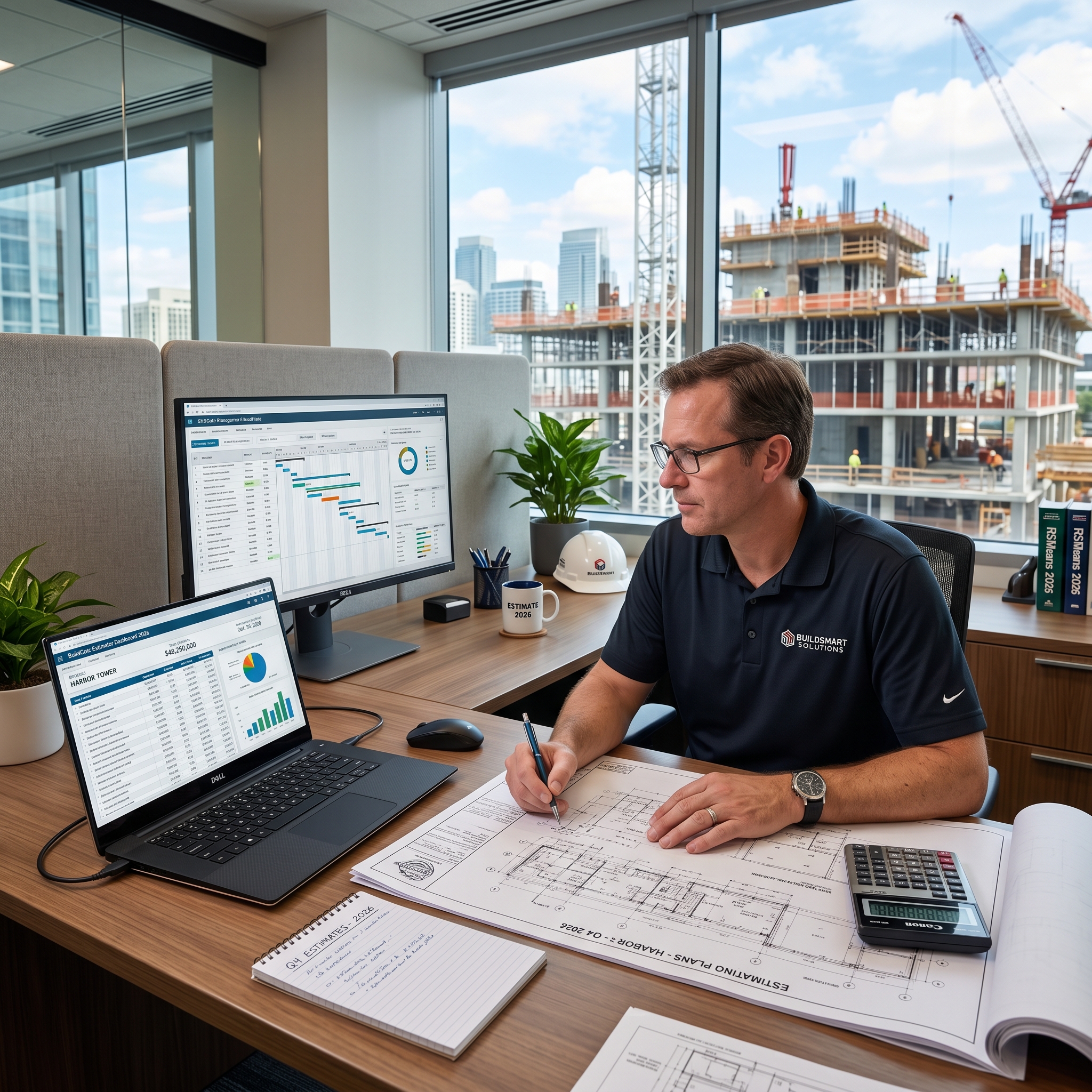
If you've ever tried to get a construction project off the ground, you know that before a single nail is hammered, someone has to figure out what the whole thing is going to cost. That "someone" — whether it's a professional estimator, a software platform, or a third-party estimating service — doesn't come free.
So what does construction estimating actually cost in the USA? And more importantly, is it worth the investment?
Let me break this down clearly, with real numbers, real examples, and the context you actually need to make a smart decision.
What Is Construction Estimating, and Why Does It Cost Money?
Construction estimating is the process of forecasting the total cost of a project before it begins. This includes material costs, labor rates, equipment, subcontractor bids, overhead, contingency margins, and profit.
A good estimate isn't a guess — it's a detailed, data-driven document that can run 20 to 200 pages for large commercial projects. Professional estimators spend years developing the skills to read blueprints, understand local labor markets, track material fluctuations, and apply accurate cost codes.
When done right, estimating saves contractors from bidding too low (and losing money) or too high (and losing the job). It's the financial backbone of every successful build.
And yes, that expertise costs money.
The Quick Answer: Construction Estimating Cost Ranges in 2025–2026
Here's a snapshot before we go deeper:
| Estimating Method | Typical Cost Range |
|---|---|
| Freelance estimator (per hour) | $75 – $200/hr |
| Professional estimating service (per project) | $500 – $10,000+ |
| In-house estimating staff (annual salary) | $65,000 – $130,000/yr |
| Estimating software (monthly subscription) | $50 – $1,500/mo |
| Cost per square foot estimate (commercial) | $1.50 – $5.00/sq ft |
| Full bid package for large commercial project | $10,000 – $50,000+ |
These ranges vary significantly based on project type, location, complexity, and who's doing the work. Let's unpack each one.
1. Hiring a Freelance Construction Estimator
Freelance estimators are independent professionals who you hire on a project-by-project basis. They're popular with small to mid-size contractors who don't have the volume to justify a full-time hire.
Typical hourly rates in 2025:
- Entry-level estimator: $75 – $100/hr
- Mid-career estimator (5–10 years): $100 – $150/hr
- Senior estimator or specialist: $150 – $200+/hr
For a residential home addition costing around $200,000, expect to pay a freelancer anywhere from $500 to $2,000 for a thorough estimate. For a $5 million commercial build, that same scope of work might run $3,000 to $8,000 or more.
Real-world example: A general contractor in Austin, Texas recently shared that they hired a freelance estimator at $125/hour for a $1.2 million mixed-use renovation. The estimator spent 18 hours on the project — total cost: $2,250. The estimate helped them win the bid and stay profitable on a tight job.
Platforms like Thumbtack, Upwork, and industry-specific networks like the American Society of Professional Estimators (ASPE) are good places to find vetted freelancers.
2. Professional Estimating Services (Third-Party Firms)
If you need faster turnaround or a more systematic approach, third-party estimating companies handle the entire process for you. They're especially popular in commercial construction, where speed and accuracy are critical to winning competitive bids.
Average fees by project type:
- Small residential project (under $500K): $500 – $2,500
- Mid-size residential or light commercial: $2,000 – $6,000
- Large commercial, industrial, or institutional: $5,000 – $25,000+
- Mega-projects (hospitals, airports, campuses): $25,000 – $100,000+
Some firms charge a flat fee, others work as a percentage of the total project cost — typically 0.5% to 2% for commercial work.
What affects the price?
- Number of trade divisions (mechanical, electrical, plumbing add cost)
- Blueprint complexity and design maturity
- Timeline (rush jobs cost 25%–50% more)
- Location (estimating in NYC or San Francisco costs more than rural markets)
- Level of detail required (conceptual vs. detailed bid estimate)
Companies like ProEst, Gordian, and Cumming Group offer full-service estimating across multiple sectors. Smaller boutique firms often specialize in specific trades or project types.
3. In-House Construction Estimators (Full-Time Employees)
Larger contractors and construction management firms often bring estimating in-house. This makes sense when you're regularly bidding 10, 20, or more projects per year.
2025 salary benchmarks for construction estimators in the USA:
- Entry-level (0–3 years): $55,000 – $75,000/yr
- Mid-level (3–7 years): $75,000 – $100,000/yr
- Senior estimator (7+ years): $100,000 – $130,000/yr
- Chief estimator / VP of Estimating: $130,000 – $180,000+/yr
According to the U.S. Bureau of Labor Statistics, the median annual wage for cost estimators across all industries was approximately $73,000 as of recent data, with construction-specific roles trending higher due to complexity and demand.
Add in benefits, payroll taxes, software subscriptions, and training, and the true fully-loaded cost of an in-house estimator runs 1.25x to 1.5x their base salary — meaning a $90,000 estimator costs closer to $112,000 – $135,000 per year in total employment cost.
For firms submitting 50+ bids annually, this investment pays for itself quickly. For smaller operations doing 10–15 projects a year, outsourcing or software solutions often make more financial sense.
4. Construction Estimating Software
The rise of digital estimating tools has fundamentally changed how the industry works. Modern platforms combine takeoff tools, cost databases, and bid management into one system — and for many contractors, they've replaced or dramatically reduced the need for outside estimating help.
Popular platforms and 2025–2026 pricing:
| Software | Best For | Monthly Cost |
|---|---|---|
| ProEst | Mid-to-large commercial | $500 – $1,200+/mo |
| Buildertrend | Residential builders | $99 – $499/mo |
| Stack | Takeoff & estimating | $49 – $299/mo |
| PlanSwift | Takeoff accuracy | $99 – $249/mo |
| Sage Estimating | Enterprise contractors | Custom pricing |
| CoConstruct | Custom home builders | $299 – $499/mo |
| Bluebeam Revu | Plan markup & review | $80 – $180/mo |
Annual subscriptions typically offer 15%–25% savings over monthly billing.
What software can and can't do: These tools are powerful for quantity takeoffs and integrating regional cost data. But they still require a skilled operator. A contractor who doesn't understand construction fundamentals won't produce a reliable estimate just by using software — garbage in, garbage out.
5. Cost Per Square Foot: A Common Benchmark
For quick feasibility estimates, many owners and developers use a cost-per-square-foot baseline. Here's how estimating fees look through that lens:
Estimating service cost per square foot (2025 averages):
- Simple residential: $0.10 – $0.50/sq ft
- Complex residential: $0.50 – $1.50/sq ft
- Light commercial: $0.50 – $2.00/sq ft
- Heavy commercial or industrial: $1.00 – $5.00/sq ft
For a 5,000-square-foot commercial office fit-out, this translates to roughly $2,500 – $10,000 for a professional estimate.
These numbers are rough guides, not firm rules. Always clarify exactly what's included in any cost-per-square-foot quote — some firms include full bid packages; others only provide a conceptual number.
What Factors Drive the Cost of a Construction Estimate?
Understanding the variables helps you budget accurately and avoid surprises.
Project complexity is the biggest driver. A straightforward wood-frame house is far easier to estimate than a hospital with specialized MEP (mechanical, electrical, plumbing) systems, infection control requirements, and phased occupancy.
Design completeness matters enormously. Estimating from schematic designs (early-stage drawings) takes longer and involves more assumptions than estimating from fully permitted construction documents. Expect to pay a premium for early-stage conceptual estimates.
Turnaround time is often underestimated as a cost factor. If a bid is due in 5 days instead of 3 weeks, you'll typically pay a 25%–50% rush premium.
Geographic market affects rates noticeably. Estimators working in high-cost metros like New York City, San Francisco, Seattle, or Boston charge more than those serving smaller markets — and with good reason. Local labor rates and material costs are genuinely different, and good estimating reflects those realities.
Number of trade scopes changes the complexity dramatically. An estimate covering only general conditions and structural work is faster than one that includes plumbing, fire protection, HVAC, electrical, low-voltage, and specialty finishes.
Do-It-Yourself Estimating: Realistic or Risky?
Many small contractors and owner-builders try to estimate their own projects to save money. Sometimes this works fine — especially for experienced builders with a strong handle on local subcontractor pricing. But there are real risks.
Common DIY estimating mistakes:
- Forgetting to account for general conditions (temporary power, portable toilets, dumpsters, project management time)
- Using national cost data that doesn't reflect local labor rates
- Underestimating the cost of permits, inspections, and utility connections
- Missing entire scope items because drawings weren't read thoroughly
- Applying outdated material pricing during periods of cost volatility
In 2022 and 2023, dozens of contractors went over budget significantly because they locked in bids based on pre-inflation lumber and steel prices, only to see costs spike 40%–80% after contract execution. A professional estimator with live market connections would have flagged those risks.
The rule of thumb: If you're bidding a job under $100,000 and you know the trades involved well, DIY estimating with solid software support is reasonable. Above that threshold, or when the margin for error is thin, professional support pays for itself.
Estimating Costs by Construction Sector
Different sectors have different estimating norms and fee structures.
Residential Construction
Residential estimating is often handled in-house by the builder or through subscription software. For custom homes, detailed estimates typically cost $1,500 – $5,000, depending on size and customization level. Production builders with repetitive floor plans can estimate much more efficiently.
Commercial Construction
Commercial estimates are more complex and more expensive. Competitive bids on mid-size commercial projects ($2M–$20M) often involve dedicated estimating teams spending 100–400 hours preparing a full bid package. Third-party commercial estimating services for this range typically charge $3,000 – $15,000.
Industrial and Infrastructure
Industrial plants, water treatment facilities, highways, and bridges require highly specialized estimating expertise. These projects often involve licensed engineers as part of the estimating team, pushing costs to $15,000 – $100,000+ for large bids.
Tenant Improvement (TI) and Interior Fit-Out
Office buildouts and retail fit-outs are a growing segment with specialized estimating needs. TI estimating typically runs $1,000 – $5,000 for a mid-size project, with faster turnarounds than ground-up construction.
Is Construction Estimating Worth the Cost?
Let me answer this with a number: the average bid-hit rate for construction contractors is around 20%–30%. That means for every job won, contractors submit three to five losing bids.
If you're spending $3,000 on an estimating service for a job bid at $2 million with a 5% margin ($100,000 in potential profit), the math is straightforward. Even if you win one in four of those bids, the cost of estimating is a small fraction of the revenue generated.
The real cost of bad estimating is far higher: underbid jobs erode margins, create cash flow crises, damage contractor-client relationships, and in the worst cases, bankrupt companies.
A story worth sharing: A mid-size general contractor in Nashville began outsourcing their estimating in 2023 after years of keeping it in-house. Their win rate dropped slightly (from 28% to 22%), but their job profitability increased by 12% on average because the estimates were tighter and more accurate. In net revenue terms, outsourcing was one of the best decisions they made.
How to Choose the Right Estimating Option for Your Business
There's no one-size-fits-all answer. Here's a decision framework:
Go with software if:
- You do repetitive project types with similar scopes
- You have internal staff who can learn the platform
- You're a small residential builder looking to scale efficiently
Hire a freelance estimator if:
- You have variable project types and periodic volume spikes
- You need specialized expertise for a one-off bid
- You're testing whether estimating investment improves your win rate
Use a third-party estimating firm if:
- You're entering a new market or project type
- You need fast turnaround on a complex bid
- You lack in-house capacity during a busy bidding season
Build an in-house team if:
- You submit 20+ significant bids per year
- Estimating is a core competitive advantage for your firm
- You're doing design-build work where integration matters
Key Takeaways and Quick Reference
- Freelance estimator rates: $75 – $200/hr
- Third-party estimating service: $500 – $25,000+ per project
- In-house estimator salary: $65,000 – $130,000/yr
- Estimating software: $50 – $1,500/mo
- Cost per square foot for estimating: $0.10 – $5.00/sq ft
- Rush fees add 25%–50% to typical project costs
- High-complexity and multi-trade projects cost more to estimate
- Professional estimating consistently improves job profitability

Frequently Asked Questions
How long does a construction estimate take? Simple residential estimates: 4–8 hours. Mid-size commercial bids: 40–120 hours. Large complex projects: 200–500+ hours.
Can I get a free construction estimate? Some contractors and estimating firms offer free preliminary estimates to win business. These are typically high-level and come with wide margins of error — treat them as starting points, not final numbers.
What's the difference between an estimate and a bid? An estimate is an internal calculation of projected cost. A bid is a formal, submitted price offered to a client. A bid is usually based on an estimate, but includes markup, profit, and specific terms.
How accurate are professional construction estimates? A well-done detailed estimate from a seasoned professional is typically accurate to within 5%–10% of actual final cost, assuming design documents are complete and scope is well-defined.
Do estimating costs vary by state? Yes, significantly. States like California, New York, and Washington have higher labor rates and estimating fees than lower-cost markets in the Southeast or Midwest.
Final Thoughts
Construction estimating is one of the most important — and most undervalued — functions in the building industry. Whether you pay $500 or $50,000, the right estimate protects your bid, your margin, and your reputation.
In 2025 and 2026, with material costs still volatile and labor markets competitive, accurate estimating has never mattered more. Contractors who invest in quality estimating — whether through software, freelancers, or professional firms — consistently outperform those who cut corners on this critical step.
Think of it this way: the cost of estimating is not an expense. It's an investment in bidding with confidence.